PV Mounting on Trapezoidal Sheet Guide
PV mounting on trapezoidal sheet: finding the right solution for metal roofs
PV mounting on trapezoidal sheet is one of the most common scenarios in commercial, industrial and agricultural construction: large, easily accessible surfaces, clear structural conditions and short installation paths. The right mounting system is decisive for both cost-efficiency and watertightness. In this guide we walk through the key planning questions: penetration-free or screwed, how to seal correctly, and when portrait or landscape mounting makes sense.
Penetration-free or screwed?
On trapezoidal sheet there are essentially two approaches. Clamp systems fix the rail to the upper flange of the profile without penetrating the sheet, but depend on the profile geometry and manufacturer approvals. Screwed solutions are fixed directly into the upper flange and cover almost any installation situation. Which approach is suitable depends on the profile, sheet thickness, wind and snow load and the roof manufacturer's specifications. In every case, a structural verification for the specific location is required.
What matters for sealing
Every fixing in the upper flange is a potential weak point. To prevent water ingress, sealing elements are used at the fixing points depending on the system. Clean cable routing is just as important: cables lying unprotected on the sheet chafe and age faster. Cable routing integrated into the profile keeps the cables securely on the trapezoidal sheet.
Portrait or landscape mounting
Whether modules are mounted in portrait (vertical) or landscape orientation determines the position of the fixing points and therefore the material requirement. Portrait mounting often follows the corrugation direction, while landscape mounting requires fixing points in the middle of the profile. A good system covers both variants with as few components as possible, keeping stock and installation simple.
M1 Trapezoidal Sheet: the single-rail concept for PV mounting
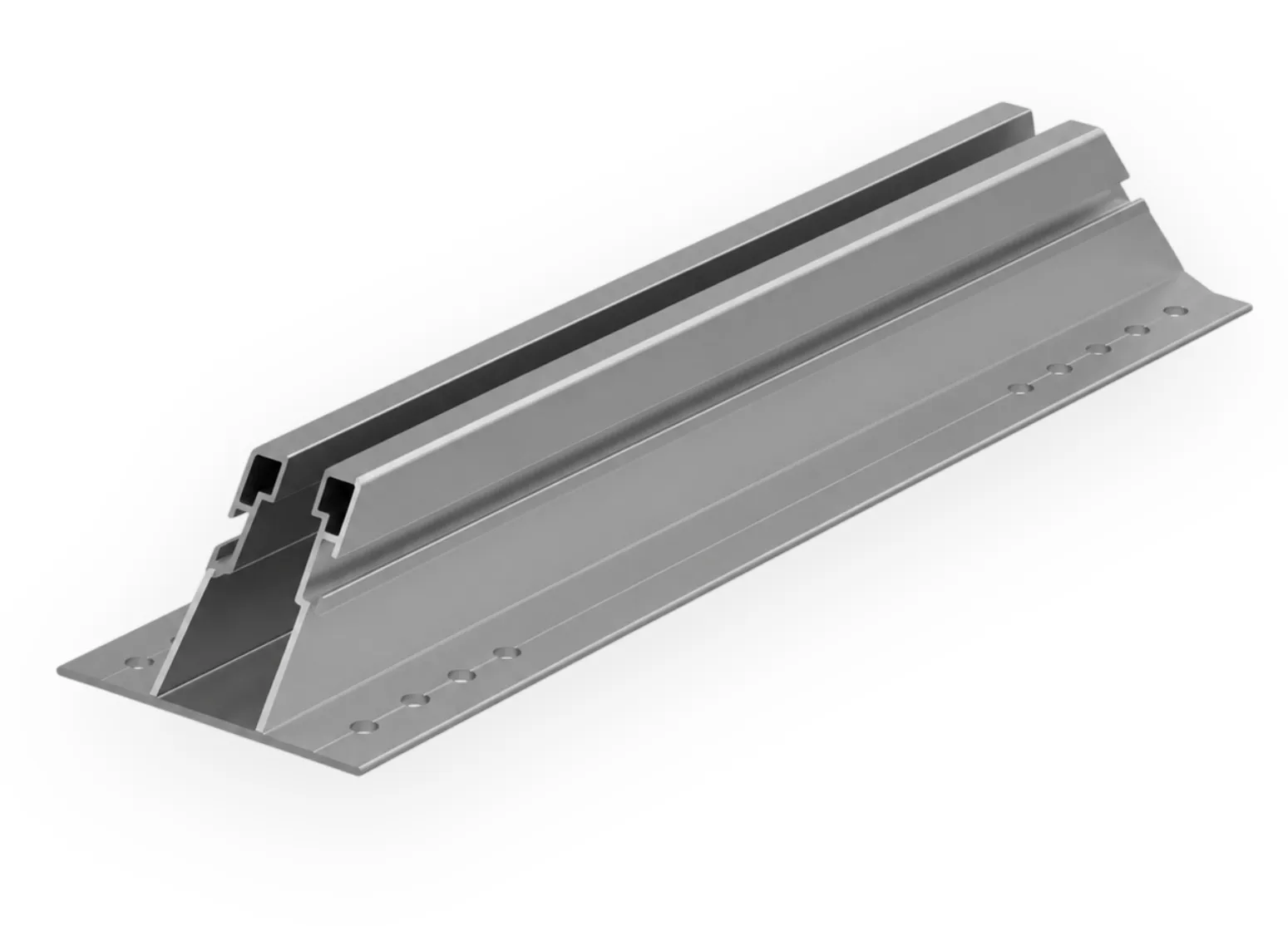
CLICKWERK developed the M1 Trapezoidal Sheet system for exactly these requirements. The principle: a single rail element, the trapezoidal sheet short rail measuring 400 x 80 x 50 mm, covers nearly any installation situation. A 45-degree cut on both sides makes the profile universally usable without additional parts, in portrait as well as landscape. This keeps stock lean and installation predictable.
The fixing is designed for flexibility: 16 + 2 fixing points are available, four holes per side (16 in total) plus two central holes specifically for landscape mounting. The integrated cable routing fixes the cables with the cable holder directly to the profile so they never lie unprotected on the sheet. The system needs only a few components: short rail, universal clamp, end clamp and cable holder. The universal clamp can be used as either a mid or end clamp.
Why it pays off for planners and installers
- One profile, every situation: the material-saving single-rail concept reduces variants in stock and logistics.
- Universal for common trapezoidal profiles: the 45-degree cut enables fast installation without additional parts.
- 25-year manufacturer warranty on the M1 Trapezoidal Sheet system.
- Made in Germany: manufactured in Hamburg, shipped from stock, usually delivered EU-wide within 2 to 4 working days.
- Structural verification: the structural report can be created with the oneClick planning software.
Detailed technical information, dimensions and components for the system can be found on the M1 Trapezoidal Sheet product page. The mounting systems overview gives you a look at the full range.
FAQ on PV mounting on trapezoidal sheet
Can I mount M1 both in portrait and landscape?
Yes. Thanks to the 45-degree cut on both sides, the short rail is designed for both orientations. For landscape mounting there are two additional central holes, making 16 + 2 fixing points in total.
How are the cables routed on a metal roof?
Via the integrated cable routing: the cable holder fixes the cables directly to the profile so they do not lie unprotected on the trapezoidal sheet.
Do I need a structural verification?
For a proper design according to wind and snow load a structural verification is standard. You can create the structural report yourself with the oneClick planning software. For questions about your specific installation situation, our team is happy to help.
Choose the right solution now
Are you planning a PV system on a trapezoidal sheet roof and want to know whether M1 fits your profile? For a complete overview of PV substructures, components and structural design, see our complete PV substructure guide. Browse the shop or get in touch with CLICKWERK in Hamburg directly via our contact page. We will advise you on the right substructure for your project.
Questions about this topic?
Our team advises you personally – on mounting systems, oneClick or your project.